
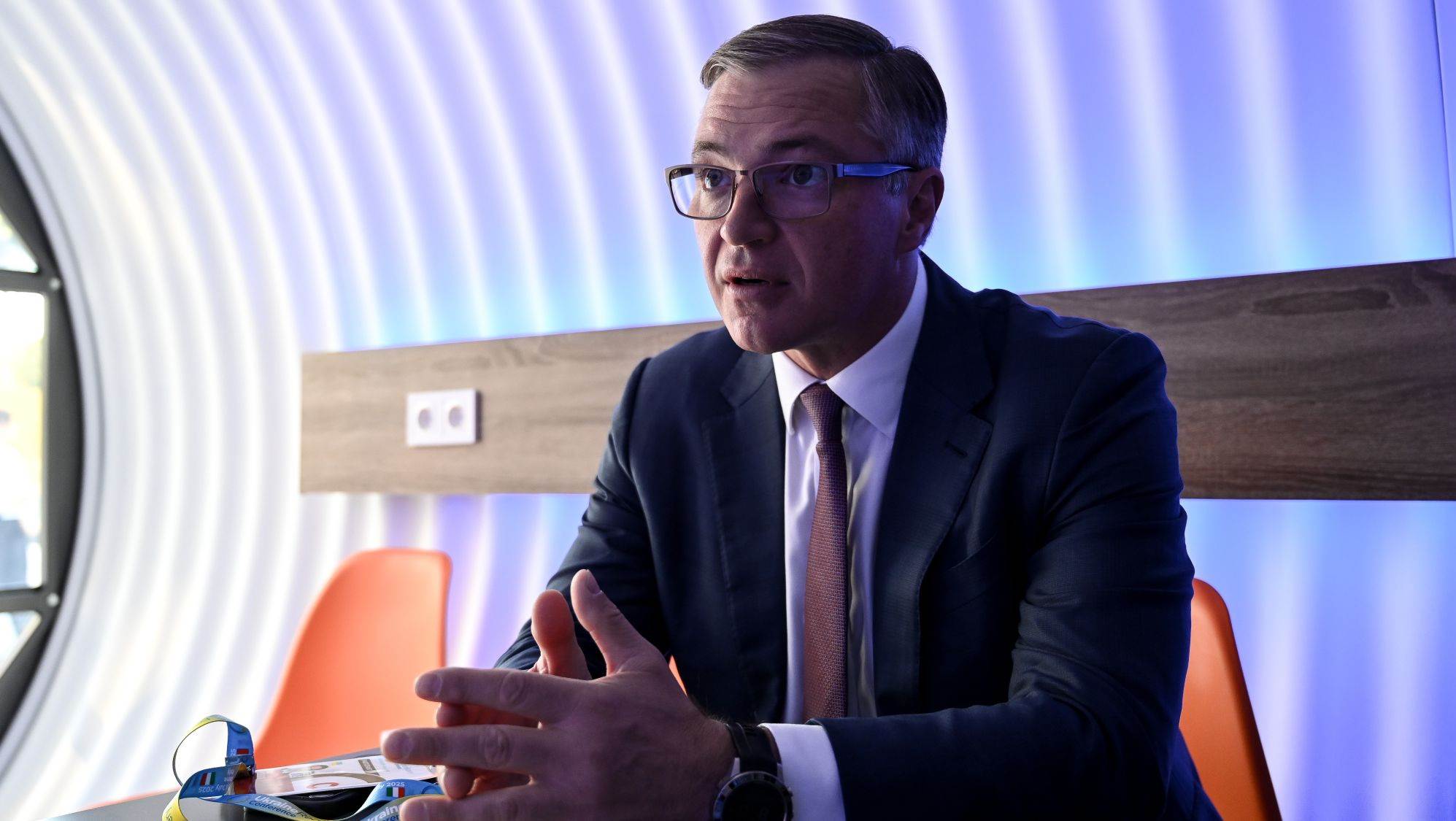
Yuriy Ryzhenkov is in an unusual position: he is a chief executive leading a company with thousands of employees through a seemingly never-ending war. He heads Metinvest, Ukraine’s largest steel producer. More than 8,000 of the Group’s employees are currently serving in Ukraine’s defence forces. Metinvest’s plants are under constant russian attack and hundreds of its employees have been killed.
Amid the flames and destruction, Ryzhenkov says this is one of the most difficult periods the Group has faced since russia’s full-scale invasion of Ukraine began more than four years ago.
“The blockade of the seaports is more severe now than it was in 2022,” Ryzhenkov, who became CEO in 2013, tells me. “Our facilities have been hit repeatedly over the past four and a half years. Although we have restored them after each attack, the losses remain significant. Every attack leaves us weaker.”
“In wartime, you cannot restore everything to its original state. You do what you can to keep operating, but even the best outcome is far from ideal. Unfortunately, following the massive russian attacks in August and September this year, we had to halt operations at both our steel mills.”
“We lost 14 people at our steel plants in these attacks. That’s where we are.”
There is now another threat to Ukraine’s steel industry: this time not from the east, but from the EU. In July 2026, the EU introduced new steel import quotas to protect EU producers from cheaper imports. Ukraine’s quota was cut by 60%. According to industry consultancy GMK Center, this could reduce Ukrainian steel exports to the EU by 1.3 million tonnes a year.
“If you compare the quotas allocated to Ukraine this year with the volume supplied last year, the reduction amounts to 60%. And this is happening while the ports remain blockaded, leaving us with no real alternative,” Ryzhenkov says.
“When the full-scale invasion began, the EU realised that the EU market had become Ukraine’s only accessible market because of the blockade of its ports. It therefore lifted all restrictions on Ukrainian steel supplies, which, in my view, was the right decision.”
“Then, suddenly, in the first half of this year, these quotas were introduced, effectively treating Ukraine in the same way as every other country [outside the EU]. The exceptional circumstances we face in terms of logistics, energy supply and personnel availability were not taken into account at all. In my view, this approach was far too harsh in the circumstances.”
Negotiations are continuing, and the EU has acknowledged the exceptional nature of Ukraine’s situation. However, this pincer movement – an armed invasion from the east and trade restrictions from the west – is placing Ukraine’s steel industry in an extremely precarious position. Between 2021 and 2025, steel production in Ukraine fell from 21 million tonnes to 7.4 million tonnes. The value of exports declined from US$22 billion to US$6 billion, while tax revenues fell from US$3.5 billion to US$870 million.
“There is virtually no future without a market in which to sell your products,” Ryzhenkov says. “With constant disruption, it is extremely difficult to keep a steelmaking business economically viable. Even under normal circumstances, such a business needs to operate at a minimum of 90% capacity utilisation to be profitable, with access to markets that support long-term commercial relationships. In the current circumstances, that is simply impossible.”
I ask whether we could be witnessing the end of steelmaking in Ukraine.
“If nothing is done, it is almost inevitable,” he replies. “It is very difficult to survive if Ukraine is not allowed to participate fully in the EU market, particularly when the circumstances also make significant investment impossible.”
Ryzhenkov comes from a family with several generations of experience in the steel industry. His grandmother worked as a chemical engineer at a coal plant closely linked to steelmaking, while his mother, father and uncle have all worked in the sector. This family background reinforces his determination to keep the business operating despite the losses and the constant threat of further attacks.
“To be honest, we don’t really have another choice, do we?” he tells me. “Of course, we could slam the door and walk away. But we have more than 35,000 employees with families. Another 8,500 of our employees are serving in the Ukrainian defence forces, and they are counting on us too. So why slam the door when we can still try to keep operating? I simply don’t see the point in doing that.”