
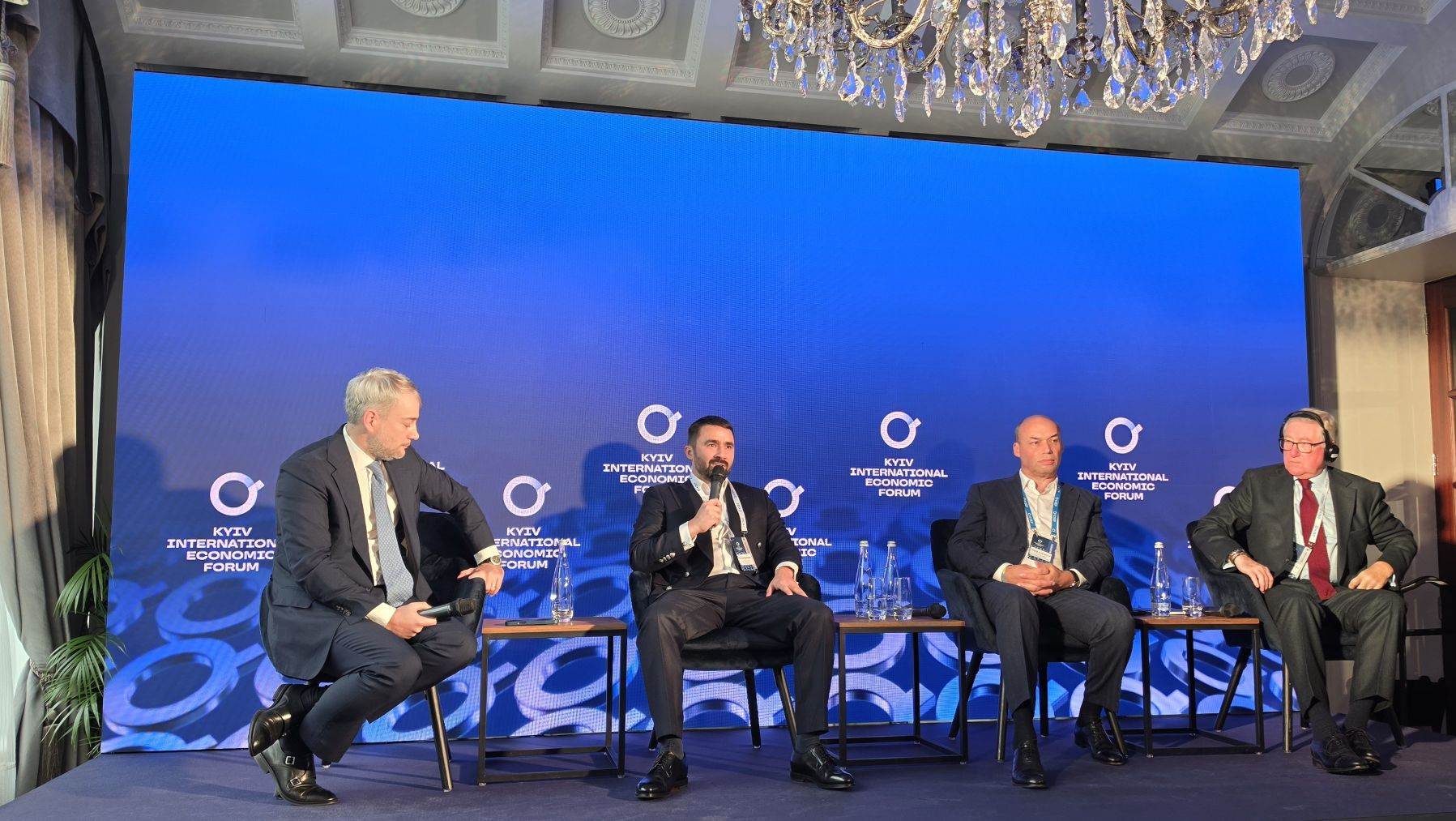
The forum brought together government representatives, business leaders, investors and experts to discuss the resilience of Ukraine’s economy during the war, investment, industrial development, energy stability and prospects for the country’s recovery.
Vodoviz took part in a panel discussion entitled “Global Markets: Closed Doors or New Opportunities?” Other participants included Taras Kachka, Ukraine’s representative to the European Union and the European Atomic Energy Community; David Godfrey, a board member of British-Ukrainian Economic Future; and Yuriy Atanasov, co-owner of CENTRAVIS.
Unequal conditions
Vodoviz believes that Ukraine must take a pragmatic approach to relations with the EU and recognise its partners’ economic interests. EU policymakers are seeking to protect domestic industries, jobs and wages. Several steel producers across the EU have gone bankrupt over the past four years, increasing the determination of EU countries to support their own manufacturers.
The EU has cut steel import quotas for Ukraine and other countries by more than 60%. Ukraine previously supplied around 2 million tonnes of steel products to the EU market each year, mainly rolled steel in coils. Its quota now stands at 670,000 tonnes.
“The quota was divided into three separate categories. The first was allocated on the basis of historical supply data from the wartime period. The second was calculated using data from the past 13 years. The third was a shared quota divided among eight countries on a first-come, first-served basis. Turkish producers used up the entire shared quota of 360,000 tonnes in the first two days. So much for the European Commission’s ‘fair’ treatment of Ukraine,” Vodoviz explained.
In his view, EU trade policy is unpredictable. Despite assurances given in 2025 that it would not introduce the Carbon Border Adjustment Mechanism (CBAM) or new quotas, the EU ultimately brought in both measures. Metinvest representatives have repeatedly met with EU officials to explain that the war has put Ukrainian producers at a disadvantage compared with their EU counterparts and that Ukrainian steelmakers pose no threat to EU producers.
Vodoviz considers this treatment of Ukraine unfair. “Out of those 18 million tonnes, Ukraine was allocated 670,000 tonnes. Can that really be called fair when we are at war, our plants have been destroyed and we have no access to finance? We are asking the European Commission to take a broader view of Ukrainian steelmakers’ access to the EU market,” he stressed.
Dependence on the EU market
With logistics chains disrupted by the war, the EU remains Metinvest’s main market for steel products. While the Group could compete in more distant markets, including China, production and delivery costs have risen sharply during the full-scale war. Electricity has become more expensive, tariffs charged by Ukrzaliznytsia (Ukrainian Railways) have increased, and marine insurance and freight costs have also risen. As a result, supplying distant markets is no longer commercially viable. Steel plants, including Zaporizhstal and Kamet Steel, were operating at just 30% of capacity even before the blockade of Black Sea ports.
“Logistics is crucial in the steel industry. We can compete in China with our iron ore products, and we can compete in the EU. But our costs have risen significantly during the war, so we have had to stop supplying more distant markets,” Vodoviz explained.
Risk of long-term restrictions
EU trade restrictions are creating difficulties even for Metinvest’s operations in the EU. Just two months after the Group acquired a pipe plant in Romania, steel import quotas restricted its ability to supply the facility. While the Romanian government has also raised the issue at a meeting of foreign ministers in Dublin, no clear answer has yet been given.
The European Commission is currently monitoring steel import volumes over a six-month period, from July to December. It will use the results to set quotas for the next five to ten years.
“We are deeply concerned that we cannot currently supply products because our plants have been damaged. There is a risk that, on the basis of these six months, we will be allocated a minimal quota for the next ten years. Our government therefore faces an extremely difficult negotiating task,” Vodoviz stated.
Lobbying by russia in Brussels
Following the introduction of sanctions against russia and a reduction in russian steel supplies to the EU, Ukrainian producers partly filled the gap left by russian suppliers. However, the presence of Ukrainian steel on the EU market has caused concern among local producers, while russian lobbyists in Brussels are seeking to push Ukraine out of the EU market.
“We can see that the russian lobby is active in Brussels. They hire firms and campaign to keep Ukraine out of the EU market. When we go into certain offices, a russian delegation is just leaving,” Vodoviz added.
Meanwhile, quotas for the steel slabs that russia continues to supply to the EU have been fixed at historical levels for five years. In other words, despite the restrictions imposed on Ukrainian producers, the volume of russian slab imports has remained virtually unchanged.
Measures to support industry
Even with limited resources, Ukraine’s government can support the steel industry through measures that do not require budgetary funding.
Metinvest supports the government’s plans to establish a war-risk insurance fund. “The question is, why did we not do this in the first year of the war?” Vodoviz added.
Another option is to secure funding from EU donors to compensate for war-related damage and rebuild strategic industries. Some of this assistance should be channelled into dedicated funds to support businesses, rather than going solely into the state budget. The Ministry of Infrastructure has already established such a fund, and Vodoviz believes a similar approach could be adopted in other sectors.
The government should also do more to defend the interests of Ukrainian producers in negotiations with the EU. Ukraine has been discussing CBAM for three years, for example, but only began tackling the issue in earnest when the restrictions started to affect businesses.
“Ukraine should have joined the negotiations at the highest level back in 2022, but we missed that opportunity. I would like the government to pay more attention to the negotiations now,” he stressed.
Another important step is to improve Ukrainian companies’ access to international finance.
“There have been many conferences on Ukraine’s recovery: in Berlin, Rome and Poland. Yet companies still have no access to international funding. Unfortunately, the Ukraine Facility programme has not got off the ground. Of the US$8 billion, companies have received no more than US$200 million, while the rest has not reached the Ukrainian economy,” Vodoviz noted.
At the same time, there are areas where the authorities’ efforts are already delivering results and should be continued. Mykola Kalashnyk at the Ministry of Infrastructure is working to restore railway infrastructure, which is vital to industry. Meanwhile, Vsevolod Chentsov and Taras Kachka are defending Ukraine’s interests in difficult negotiations with the EU. It is important that they have the support of both the government and the business community, as the outcome of their work will also shape Ukrainian producers’ access to the EU market.